Reading Your Interview Report
Understand the overall score, dimension radar, question-by-question review, and improvement suggestions — and turn one mock into next time's gain.
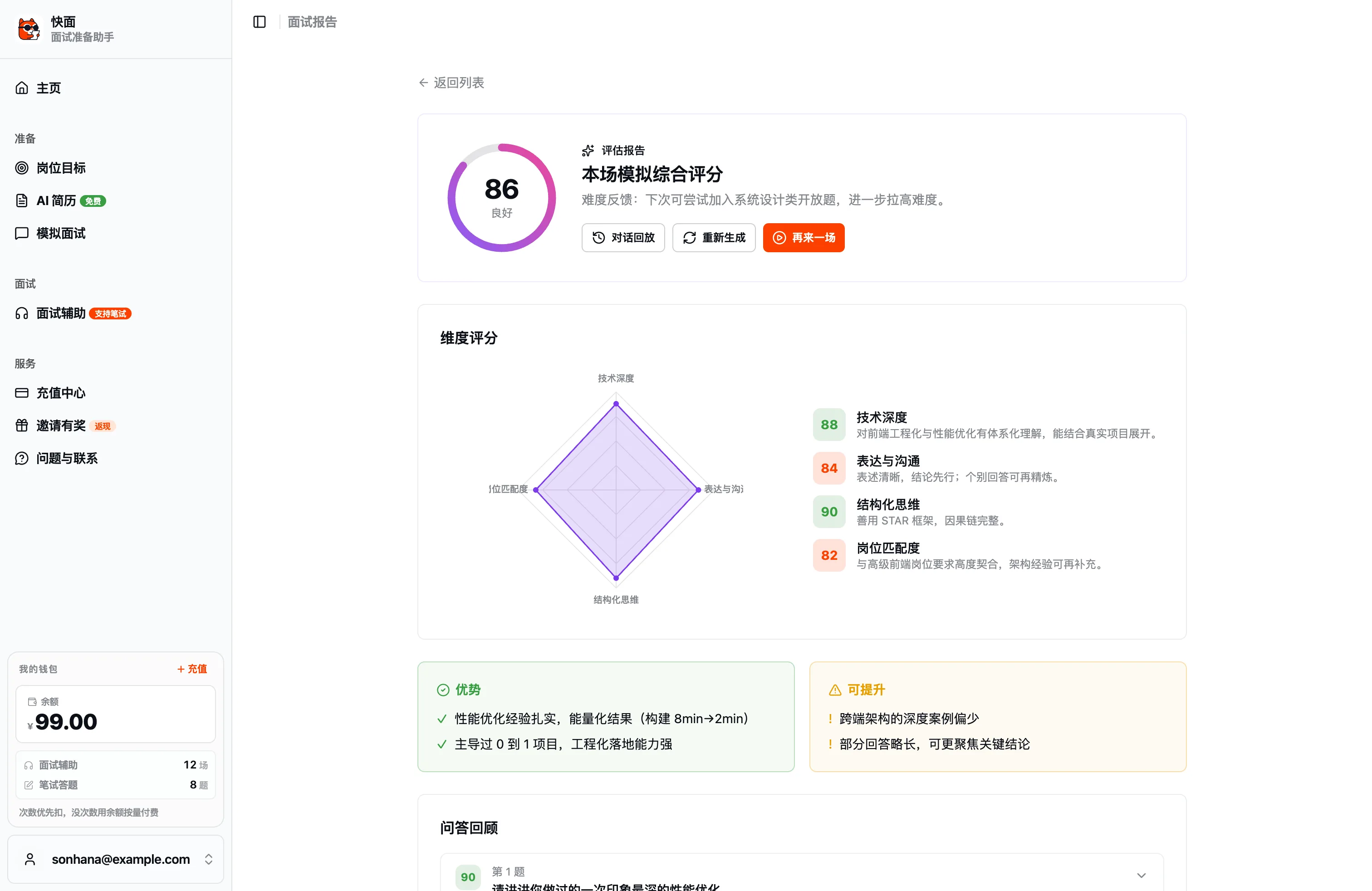
After each mock interview, Kuaimian generates a structured assessment report: an overall score, a multi-dimensional radar chart, lists of strengths and areas to improve, a question-by-question review, and targeted follow-up suggestions. The value of the report isn't the score itself but the way it breaks "how did I do this round" into actionable improvements — practice them, and you'll see a change next round.
Overall score
At the top of the report is this round's overall score (0–100) and a one-line difficulty note. The score is just a quick reference; the matching qualitative tier helps you calibrate expectations:
| Range | Tier | Meaning |
|---|---|---|
| 90+ | Excellent | Consistent performance with standout moments |
| 80–89 | Good | Solid overall, a few things to polish |
| 70–79 | Pass | Meets the baseline, with clear room to improve |
| 55–69 | Marginal | Key weaknesses are holding you back |
| < 55 | Needs work | Recommend targeted reinforcement before trying again |
Dimension scores
The radar chart breaks performance into several dimensions, each scored individually. Common dimensions include technical depth, communication, structured thinking, and job fit (the exact dimensions vary by job type). Each dimension comes with a one-line comment on what was good and what was lacking. Looking at the dimensions is more useful than the total — they tell you directly which direction to push.
Strengths and areas to improve
The report lists this round's strengths and areas to improve in two columns:
- Strengths: What you nailed this round, worth keeping up in real interviews.
- Areas to improve: The weaknesses exposed, your priority targets for the next practice round.
These two lists are qualitative conclusions — more concrete and actionable than a score.
Q&A review
Expanded question by question, each with its own score, preserving the full question and your answer. Combined with the live transcript, you can pinpoint exactly: which question went off the rails, what you said at the time, and what a good answer should have added. This is the key step that turns a vague "I don't think I answered well" into a specific question.
Follow-up suggestions and iteration
The end of the report gives targeted study suggestions — each explaining what topic to shore up and why, some with learning resources attached. A suggested iteration rhythm:
- Cross-reference "areas to improve" and low-scoring dimensions to lock in the 1–2 points most worth shoring up.
- Follow the "follow-up suggestions" to fill in the corresponding knowledge or practice your delivery.
- Run another mock with the same job and compare the dimension scores to verify the improvement.
The report page supports "conversation replay" (revisit the whole process), "regenerate" (re-evaluate from a fresh angle), and "retry" (jump straight into another round with the same job) at any time. Treat each report as a practice checklist for the next round — iterate a few times, and the progress will be obvious.