How to Negotiate Salary After Getting an Offer: Timing, Scripts, and Your Bottom Line
Negotiating isn't greedy—it's about getting paid for the value you've proven. From when to bring it up, to how to name a number, to handling "our budget is limited," to holding your line: a negotiation rhythm that earns more without damaging the relationship.
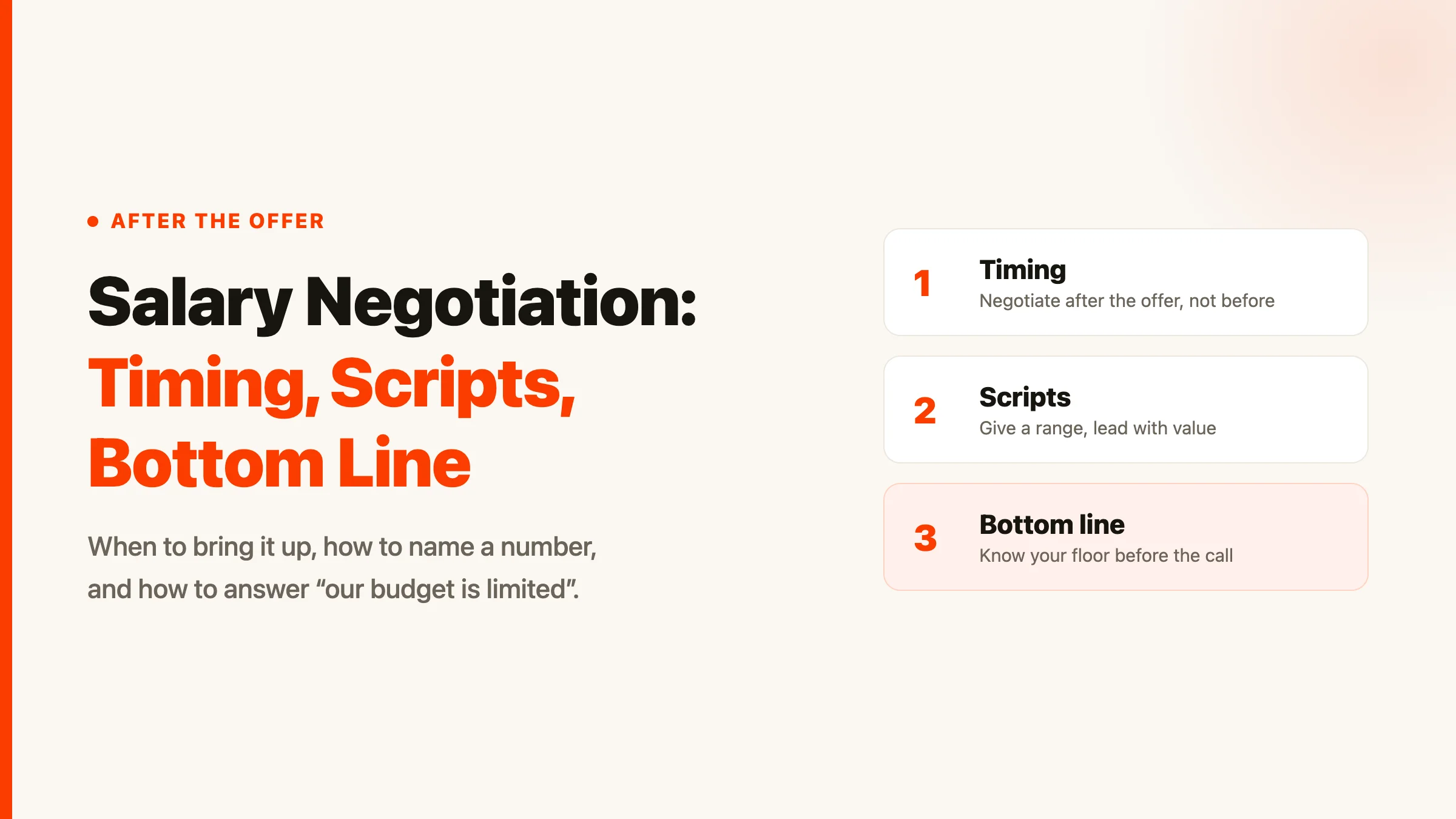
Many people fight their way through round after round, only to rush to sign at the salary stage—either too embarrassed to speak up, or surrendering at a single "this is all we've budgeted." In truth, salary negotiation is one of the highest-ROI few minutes in the whole hiring process: one tasteful push can mean a difference of months or even years of pay. It isn't greed—it's negotiating the value you've already proven up to a matching number.
First Principle: Let Them Name a Number First
The core game of salary negotiation is "who anchors first." If you can get the other side to speak first, don't go first yourself.
- When asked about your expected salary, you can ask back: "What's the budget range for this role on your end? I'd like to see whether it's a fit."
- If you really must go first, give a range, and place your target value toward the lower end of that range (so the range skews high overall).
- Before naming a number, do your homework: check the going rate for the same role in the same city, and for the same level at the same company, so your number has a basis rather than being a shot in the dark.
Second Principle: Pick the Right Timing
The best window to negotiate is after you've received a verbal or written offer, but before you've formally accepted. This is when your leverage is greatest—they've already decided they want you, and the cost of re-recruiting far outweighs giving you a bit more. Bringing up money before you have an offer is too early in the rhythm and can come across as "only caring about money."
A Salary Negotiation Script Template
Express enthusiasm + give a basis + make a specific ask—this three-part structure has force without damaging the relationship:
Thank you so much for this offer; I'm really excited about the team and the role. Given my experience in ××, and the current market rate for comparable-level positions, I'm hoping the base salary can reach the level of ××. Could we talk about that number?
A few key points:
- Always lead with thanks and interest, so they know you want to come—you just want to land on the right number.
- Tie it to concrete value: "Given my experience in ××," not "I think I'm worth this much."
- Give a clear target number; don't just say "can it be a bit higher"—a vague ask gets a vague answer.
How to Respond to Common Deflections
| If they say | You can respond with |
|---|---|
| "This is all we've budgeted, we can't add more" | "Understood. Beyond base salary, is there room on signing bonus / equity / the raise cycle?" |
| "This is our standard pay" | "What I care about is the total package—if base is fixed, could you top it up on the year-end bonus or equity?" |
| "Join first, we'll talk about a raise next time" | "I'm very willing to grow long-term—could you write the next review date and rough increase into the offer?" |
Remember: when base salary won't budge, there are still plenty of negotiable items in the total package—signing bonus, year-end bonus, equity, raise cycle, start date, remote days, and supplemental leave.
Hold Your Bottom Line, Close Gracefully
Before negotiating, get clear on two numbers: your ideal value (the goal you're pushing for) and your bottom line (below which you won't accept).
- When negotiating, ask for your ideal value while quietly holding your bottom line.
- Stay friendly throughout—you're negotiating with future colleagues and bosses, and there's no winner in burning bridges.
- Once a deal is reached, confirm it promptly and give a clear answer quickly; don't drag it out and drain trust.
- Once you have the adjusted terms, be sure to get them into the written offer before you sign.
Negotiating Confidence Comes From Your Earlier Performance
How much you can ask for in negotiation depends largely on how thoroughly you proved your value during the interview. Build a solid foundation in both the resume and interview stages—use Kuaimian's AI Mock Interview to drill high-frequency questions in advance and put numbers to your project outcomes—the more the interviewer values you, the firmer your anchor when it's time to negotiate.
There's no shame in negotiating salary—falling short on preparation is what costs you points. Push for what's yours, tastefully.
Ready?
For your next interview, use Kuaimian
Start free: try resume optimization and mock interviews to get a feel for how the AI responds, then decide whether to top up on interview assistance.