How to Prepare for System Design Interviews: A Reusable Framework
System design interviews have no standard answer, but they do have a standard approach. A framework that runs from clarifying requirements to capacity estimation to core components and scalability—plus a checklist of common topics—to help you make sense of those 45 minutes.
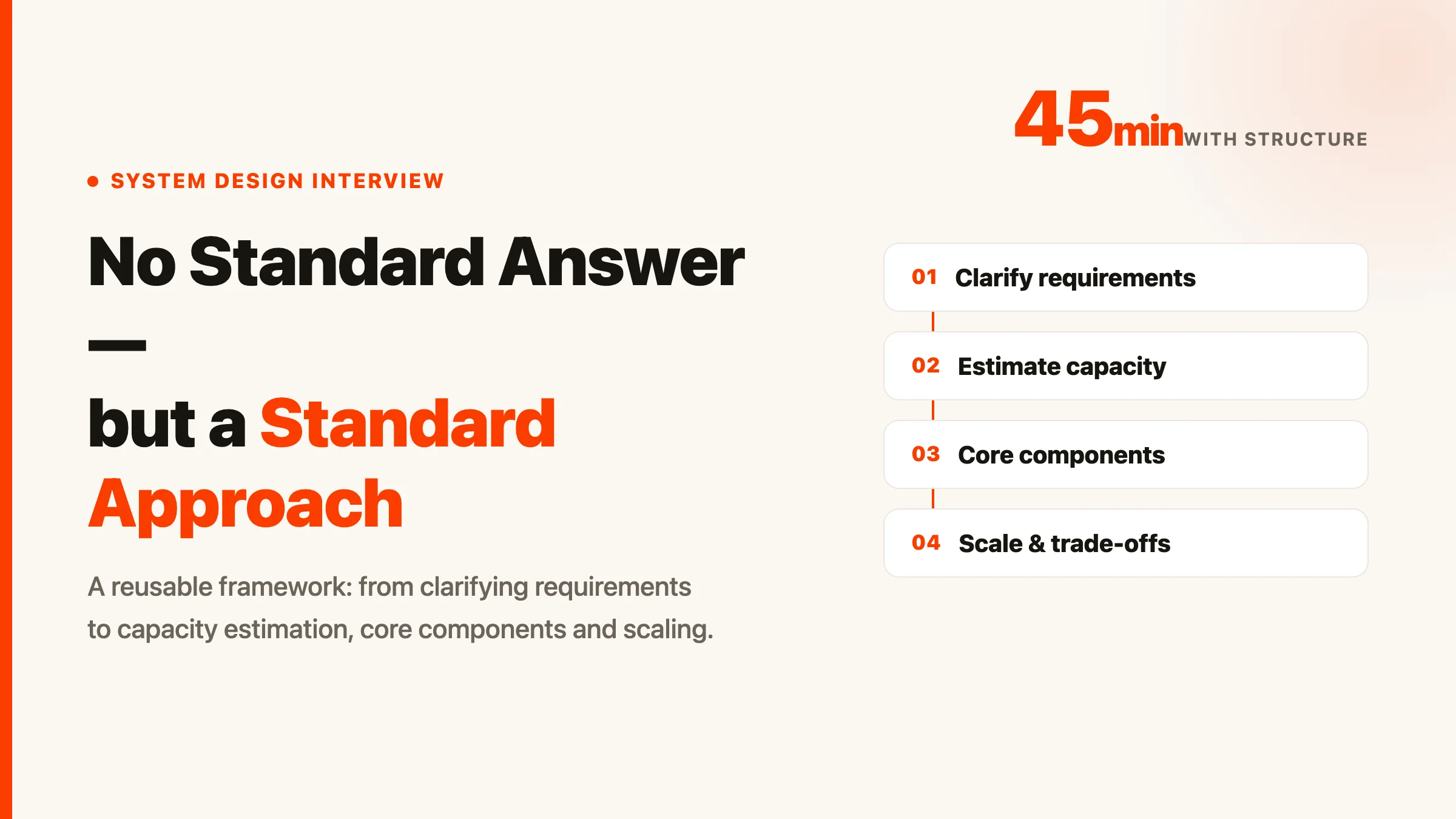
The scariest thing about system design interviews is that they "have no standard answer"—the prompt is often a single line: "Design a URL shortener," "Design a social feed." But open-ended doesn't mean structureless. What truly separates candidates isn't who remembers the most, but who can take a vague problem in 45 minutes and break it apart, make trade-offs, and reason it through with structure. The framework below can be applied directly to almost any system design question.
A Five-Step Framework
Step 1: Clarify requirements (5 minutes, don't skip)
Jumping straight to drawing an architecture is the biggest trap for beginners. Spend a few minutes making the prompt concrete first:
- Functional requirements: What are the core features? Which are MVP, and which can be deferred?
- Non-functional requirements: Read-heavy or write-heavy? Do you need strong consistency? Latency targets?
- Scale: How many daily active users? What QPS magnitude? How long is data retained?
Pinning down the scope aligns expectations and also shows the interviewer your product sense.
Step 2: Capacity estimation (5 minutes)
Use rough numbers to work out the system's magnitude—it directly drives your later technology choices. Just memorize a few common baselines:
| Quantity | Order of magnitude |
|---|---|
| Seconds in a day | ≈ 86,400 ≈ 10⁵ |
| One text record | ~ 100 B ~ 1 KB |
| Single-machine QPS (cache hit) | ~ tens of thousands |
| Single-machine storage | ~ TB scale |
For example, "100M DAU, 1 write per person" ≈ 100M writes/day ≈ 1,000 write QPS; at a 100:1 read ratio that's 100,000 read QPS—and right away you know you must add caching and read-write splitting.
Step 3: Define the API and data model (5 minutes)
List the core endpoints (POST /shorten, GET /{code}) and the main table/collection fields. This step grounds the abstract problem and sets up the storage choices for the next step.
Step 4: Draw the high-level architecture (15 minutes, the core)
Start from the simplest "client → load balancer → service → database," then add components step by step to solve specific bottlenecks:
- Cache (Redis): absorb reads, lower latency; watch out for cache penetration / avalanche / consistency
- Message queue (Kafka): shave peaks, decouple, make writes asynchronous
- Sharding / read-write splitting: how to split when a single database can't keep up
- CDN / object storage: static assets and large files
- Consistent hashing: balancing across shard or cache nodes
Every time you add a component, make clear "which specific problem it solves," rather than piling up buzzwords.
Step 5: Deep dive and trade-offs (10 minutes)
The interviewer will usually pick one point to probe deeply. Proactively show your sense of trade-offs: SQL vs. NoSQL, strong vs. eventual consistency, push vs. pull (the classic feed dilemma). There's no silver bullet; what matters is explaining why this choice for this scenario.
Quick Reference: Common Topics
- URL shortener / ID generator: hash vs. auto-increment, Base62 encoding, collision handling
- Feeds: push (fan-out on write) vs. pull (fan-out on read) vs. hybrid
- Rate limiting: token bucket / leaky bucket / sliding window
- Unique IDs: Snowflake, segment-based allocation
- Flash sales / high-concurrency writes: inventory pre-deduction, queue peak-shaving, oversell prevention
Drill the Framework Into Muscle Memory
The hard part of system design is "organizing on the spot," and that only comes from speaking it out loud. Pick a few classic questions and run through them against the five steps above, on a timer. Practicing alone makes it easy to feel falsely good about yourself—drop the question into Kuaimian's AI Mock Interview, let the AI play the interviewer and probe at the key moments ("why not strong consistency," "what if the cache goes down"), and you get much closer to real pressure—plus a piece of structured feedback afterward that tells you which step you missed.
Remember: a system design interview isn't testing how many architectures you've memorized—it's testing whether you can make reasonable trade-offs, with structure, amid uncertainty.

Ready?
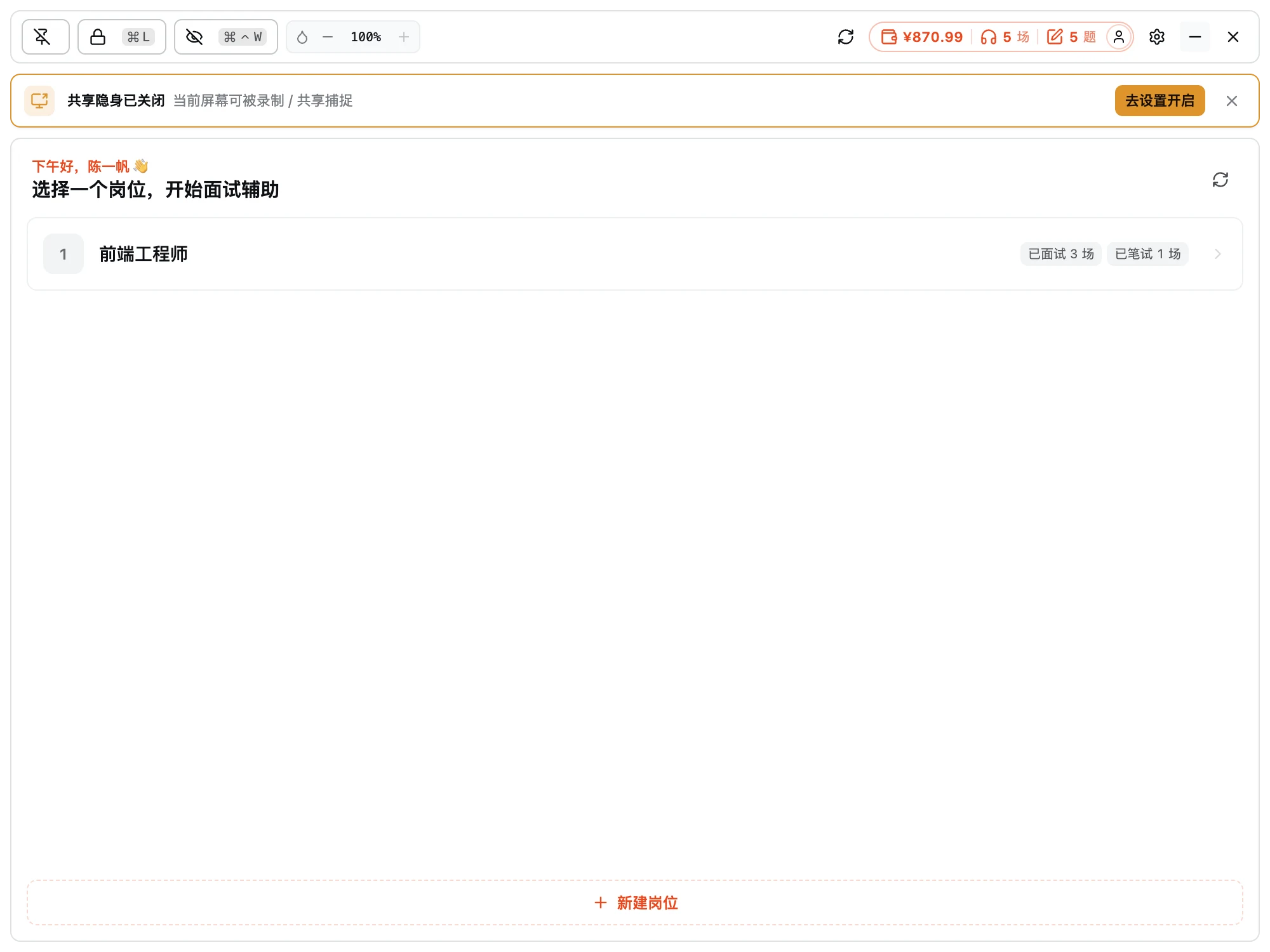
For your next interview, use Kuaimian
Start free: try resume optimization and mock interviews to get a feel for how the AI responds, then decide whether to top up on interview assistance.